Monday, August 13, 2012

Link Round-Up: August 13, 2012

http://25.media.tumblr.com/tumblr_m8oxq3qSbq1qij2hso1_500.jpg

This full-resolution self-portrait shows the deck of NASA’s Curiosity rover from the rover’s Navigation cameras.

Amazing Perseid Meteor Shower Photos of 2012

The Internet Archive is now offering over 1,000,000 torrents including live music concerts, the Prelinger movie collection, the librivox audio book collection, feature films, old time radio, lots and lots of books, and all new uploads from our patrons into Community collections (with more to follow). There are a few real gems buried in there, including House on Haunted Hill and Night of the Living Dead.

Life on the Internet: This is a strangely beautiful piece on what it’s like to live life “on” the internet.

Peanuts, Blackjack and Pee: Strangest Space Mission Superstitions

WIRED has been running a fascinating series: Olympic Physics: Can Runners Benefit From Drafting?, Scoring the Decathlon, New [Swimming] Platform Is No Chip Off The Old Block, Air Density And Bob Beamon's Crazy-Awesome Long Jump, How The Hammer Throw Is Like A Particle Accelerator and is also Exciting and Artisitc

Friday, August 10, 2012

Tech Links: August 10, 2012


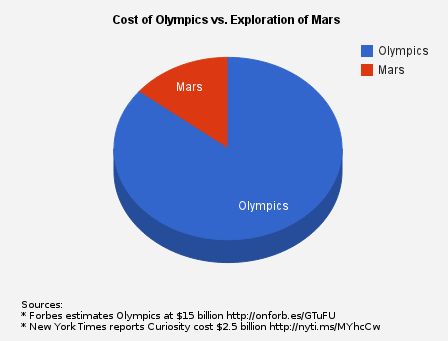
The most appalling infographic you’ll see today compares the cost of the Olympics vs. the cost of landing Curiosity on Mars. And yet, the future of space exploration is more precarious than ever.

Entertainment


If Hemingway wrote JavaScript

The surprising, stealth rebirth of the American arcade

Twitter has leaked into the “real world” so much these days that someone took it upon themselves to “invent” the equivalent of finger air-quotes, this time to indicate you’re speaking in hashtags.

Gadgets


David Pogue, the tech columnist for The New York Times, lost his iPhone. Thanks to his 1.4 million Twitter followers, and the Prince George's County police department, it has been found

The portable 3D printer that fits in a briefcase: Two MIT students created an ultra-compact machine with a detachable head.

A Surprisingly Long List of Everything Smartphones Replaced

Internet


Infographic: Design Evolution On The Web Explained

Google Fiber: Here’s what you need to know

Rather than reading the terms of service for your favorite social media or other sign-up service online, you can see how they fare with easy-to-read iconic summaries on this handy “ToS; Didn’t Read” website.

Vilnius, Lithuania-based creative agency New! took it upon themselves to make a better Wikipedia. New! improved the site visually, made it more user-friendly and above all made a beautiful design. 

A viral video about the phenomenon of viral videos.

Reading & Discussion


Does Cybercrime Really Cost $1 Trillion?

Women and tech: Why don't girls want to be geeks?

Science


Curiosity rover landing on Mars: This is how we should explore the solar system.

Software


Chameleon Clock is an iPhone and iPad clock app that uses the device’s camera to match the screen background to whatever is behind the device for a see-through effect. The app is by Belgian developer NetwalkApps.

Software Runs the World: How Scared Should We Be That So Much of It Is So Bad?

Technology


A Day Job Waiting for a Kill Shot a World Away

Tutorials


Toasted Leg Syndrome, or erythema ab igne, is / are a pronounced skin burn, usually on the thighs, that can lead to permanent discoloration and even melanoma. And you can get it from using a laptop - on your lap. One solution: Make your own cooling pad (1, 2). But that won't help you if you toast the undersides on the warmed seat of your fancy car.

Video Distraction: ISS Time-lapse Photography


From high above the Earth, the International Space Station (ISS) provides a unique vantage point to view our home planet. Stunning time-lapse photography of cities, aurora, lightning and other sights are seen from orbit. Famed astronomer Galileo imagined these views from space and now through the technological marvel of the space station, we can see them for ourselves.

Thursday, August 9, 2012

Science: Water in Zero Gravity


Experimenting with the physics of water in the weightless environment aboard the International Space Station.

Lecture: The Biological Advantage of Being Awestruck


[...] our ability to awe was biologically selected for by evolution because it imbues our lives with sense of cosmic significance that has resulted in a species that works harder not just to survive but to flourish and thrive…

Humor: Martian Invader


Source: The Miami Herald

Tuesday, August 7, 2012

News: Curiosity Rover lands safely on Mars


NASA’s Curiosity Rover lands safely on Mars. Here’s what it took and how it happened.

News: NASA Announces Next Steps


NASA Announces Next Steps in Effort to Launch Americans from U.S. Soil:
NASA and its Commercial Crew Program announced new agreements with three American commercial companies to design and develop the next generation of U.S. human spaceflight capabilities, enabling a launch of astronauts from U.S. soil in the next five years.
Advances made by these companies under newly signed Space Act Agreements through the agency’s Commercial Crew Integrated Capability (CCiCap) initiative are intended to ultimately lead to the availability of commercial human spaceflight services for government and commercial customers.
SpaceX’s crewed Dragon will get more lift capability from the next-generation of Falcon rockets. The uncrewed version of Dragon recently made history as the first commercially built spacecraft to rendezvous and then berth with the International Space Station.
Sierra Nevada Corporation will advance its Dream Chaser spacecraft, which resembles NASA’s space shuttle but is smaller and based on improvements to the agency’s HL-20 lifting-body design. The company partnered with United Launch Alliance to launch its spacecraft atop an Atlas V rocket.
Boeing will continue to develop its CST-100 spacecraft, which underwent rigorous testing during two previous commercial crew development phases. It too will launch atop an Atlas V.
Source: Nasa.gov

Monday, August 6, 2012

Tech: A Microscopic Archive of World Languages


Daily Links: August 2, 2012


This is truly astonishing: the HiRISE camera on the Mars Reconnaissance Orbiter snapped what may turn out to be the Space Picture of the Year: Curiosity descending to Mars under its parachutes!


10 Insane Things You Didn't Know 3D Printers Could Do

After The Final Curtain has posted some photos of the inside of Coney Island’s SHORE theater which has been closed since the 70s. If you’ve ever been to Coney Island, you’ve no doubt seen the exterior of this beautiful theater. The inside however, is a different story, mostly falling into heavy disrepair and most likely demolition.

The Castaway's Guide To Making A Home: What do people do when they're shipwrecked on a deserted isle?

Global issues as depicted by Olympic rings.

Man texts, "I need to quit texting," before driving off cliff.

Simple Desks: A frequently updated collection of beautifully minimal desks and workspaces, interspersed with occasional musings on minimalism, productivity, design and technology 

Photo: Trifid Nebula


Friday, August 3, 2012

Video Distraction: How It's Made: Cardboard Boxes


There's something about complex manufacturing processes that I find completely entrancing. I thought that I would share this one.

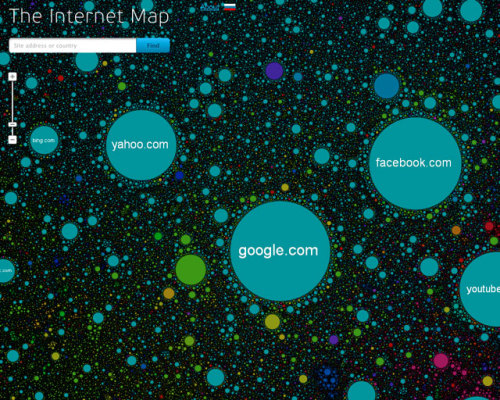
Net: Internet Map


Internet Map is a data visualization of 350,000 websites, based on a snapshot of the Internet from late 2011. Each site is represented by a circle—the size of the circle indicates traffic. Sites that link often to one another are closer together, creating “constellations” of connected sites. Laughing Squid is on the map, not far from Tumblr, Flickr, and Reddit. The Internet Map was created by program developer Ruslan Enikeev.

Snippet

"The combined level of robotic chatter on the world’s wireless networks — measured in the digital data load they exert on networks — is likely soon to exceed that generated by the sum of all human voice conversations taking place on wireless grids. “I would say that is definitely possible within 10 years,” said Miguel Blockstrand, the director of Ericsson’s machine-to-machine division in Stockholm. “This is a ‘What if?’ kind of technology. People start to consider the potential, and the possibilities are endless.”

-  Talk to Me, One Machine Said to the Other

Tech: Human Body on a Chip Research


DARPA and NIH to fund ‘human body on a chip’ research

DARPA and NIH to fund ‘human body on a chip’ research:
MIT-led team to receive up to $32 million from DARPA and NIH to develop technology that could accelerate pace and efficiency of pharmaceutical testing

Researchers in the Department of Biological Engineering at MIT plan to develop a technology platform that will mimic human physiological systems in the laboratory, using an array of integrated, interchangeable engineered human tissue constructs, with $32 million funding over the next five years from the Defense Advanced Research Projects Agency (DARPA) and the National Institutes of Health (NIH).

A cooperative agreement between MIT and DARPA worth up to $26.3 million will be used to establish a new program titled “Barrier-Immune-Organ: MIcrophysiology, Microenvironment Engineered TIssue Construct Systems” (BIO-MIMETICS) at MIT, in collaboration with researchers at the Charles Stark Draper Laboratory, MatTek Corp. and Zyoxel Ltd.
Source: Kurzweilai

Science: Visualizing Prime Numbers


Visualizing Prime Numbers

Jason Davies has created a way to visualize prime numbers as periodic curves (curves that repeat every n points). Wherever only two curves intersect (for 1 and the number), that’s a prime. Play with the interactive, zoomable version here.

Photo: Cave Nebula


Tech: Researchers Develop Body Extender Suit

Researchers Develop Body Extender Suit
via 33rdsquare:

Once the preserve of science fiction, increasingly sophisticated robotic devices are vying for a place side by side with humans in the real world. Researchers are currently working on a Body Extender robot at the Perceptual Robotics Laboratory at Sant’Anna University in Pisa, Italy. The exoskeleton or “body extender”, a prototype costing millions is a armour suit weighing 160 kilos which multiplies the strength of its human user 20 times.

[read more] [Sant’Anna University] [video (embedding is disabled)]

Researchers Develop Body Extender Suit:
Once the preserve of science fiction, increasingly sophisticated robotic devices are vying for a place side by side with humans in the real world. Researchers are currently working on a Body Extender robot at the Perceptual Robotics Laboratory at Sant’Anna University in Pisa, Italy. The exoskeleton or “body extender”, a prototype costing millions is a armour suit weighing 160 kilos which multiplies the strength of its human user 20 times.
Source: 33rdsquare

Documentary: Blueprint for the Brain


Blueprint for the Brain is a 6-minute film by PBS and the Public Library of Science explores how the three-pound lump of jelly inside our skulls enables us to do everything that makes us human, and how scientists are now beginning to decipher the architecture of the brain and its secret lives.

Thursday, August 2, 2012

Business: Google’s Quirky New London HQ


Google’s Quirky New London HQ: Fit For Mr. Bean:
The search giant is known for its playful, unconventional workspaces—perhaps intended to offset its fairly Vader-esque public image, and certainly, to sweeten the deal for young, in-demand engineers who may be juggling other offers. In Pittsburgh, Googlers enjoy an industrial theme and slides. In Zurich, it’s birch trees and meeting cocoons. Meanwhile, in London, Google has two established offices—one is industrial chic, the other, a space-age white box. Now, a third office—a “Super HQ”—has opened on the eighth floor of Central Saint Giles, the Renzo Piano-designed tower in Covent Garden.
Source: Fastcodesign.com


Science: Billionaire Planning to Clone a Dinosaur?


Australian billionaire planning to clone a dinosaur?

Australian mining billionaire Clive Palmer is rumoured to be in deep discussion with the same group who successfully cloned Dolly the Sheep, to clone a dinosaur and keep it in a new resort he is building in Coolum, on Australia’s Gold Coast.

This is the same businessman who recently unveiled plans for the ‘Titanic II’ cruise liner. He has an estimated A$8 billion fortune.

A press conference is expected today, August 3, where Mr Palmer will reveal plans about the planned resort.
Source: Sunshinecoastdaily.com

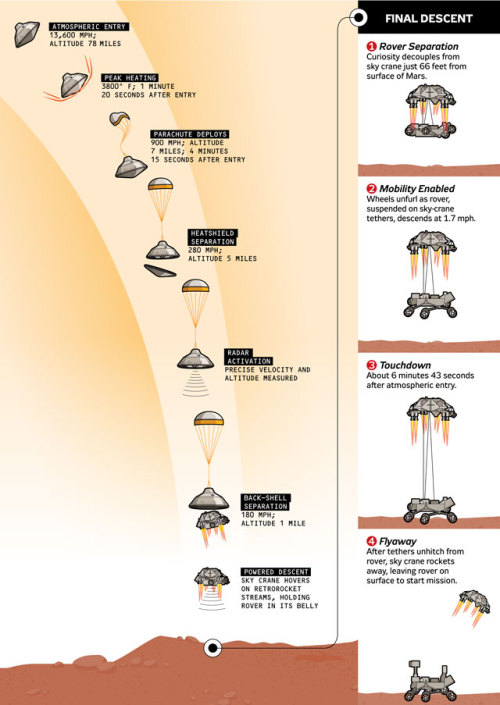
Infographic: How Curiosity will land on Mars

We posted this back in spring, but in case you missed it then: How Curiosity will land on Mars, in 11 easy steps. 
Plus: The Anatomy of Curiosity.

How Curiosity will land on Mars, in 11 Easy Steps

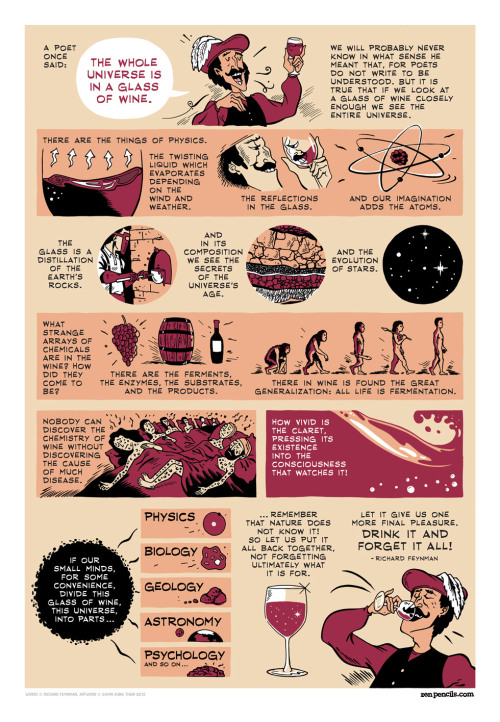
Quote

well said, mr. feynman.

Richard Feyman
Source: Zen Pencils

Lecture: String Theory in 26 Seconds


String Theory in 26 Seconds by George Musser

Looking for a more detailed explanation? Watch string theorist Brian Greene: The Universe On A String.

Lecture: Measurement


Paul Lockhart, author of the famous Mathematician's Lament, has a new book coming out called Measurement, which tries to discuss mathematics "as an artful way of thinking and living". Lockhart discusses his passion for math and motives for writing the book in this video.

Photo: Young Star Cluster Westerlund 2

n-a-s-a:

Young Star Cluster Westerlund 2 
Credit: Y.Nazé, G.Rauw, J.Manfroid (Université de Liège), CXC, NASA 

Young Star Cluster Westerlund 2
Credit: Y.Nazé, G.Rauw, J.Manfroid (Université de Liège), CXC, NASA

Wednesday, August 1, 2012

Daily Links: August 1, 2012


The 12 Most Unique Playgrounds in the World

10 Most Notorious Wikipedia Editing Scandals

Ever wonder what happens when the Olympic flame dies?

Here's a nifty realtime Olympic medal tracker that allows you to sort by rank, country, total, gold, silver, and bronze medals. Too obvious for you? There are plenty of alternatives: medals per capita ; medals by GDP per capita; number of athletes and billions of dollars GDP per medal (2008); and a discussion of alternative rankings with a sortable rankings table.

The New York Post is reporting that Westside Market, a grocery store in New York City’s Upper West Side, has just launched a “Man Aisle” for their “shopping-challenged” male patrons.

Video Distraction: Stop-Motion Video of Paris


Photo: Mirror of the Earth


Salar de Uyuni in Southwest Bolivia, the largest salt flatland in the world at 4,086 square miles, is so extremely flatty that space-faring satellites use it for atmosphere calibrations. As detailed in these pictures, Salar experiences an annual flooding producing a thin sheet of highly reflective water that seems to mirror the sky. I want to go to there.


Tuesday, July 31, 2012

Humor: Synchronized Tweeting

New Olympic Sport: Synchronized Tweeting

The newest Olymic sport, Synchronized Tweeting, envisioned by Dan Piraro of Bizarro

Gadgets: Smell Printer


O.k this is pretty crazy, The “Food printer” has a camera, a smell extractor and a printer. When you’re ready to go the camera snaps a shot of the food while the smell extractor gathers the smells and the printer than prints the postcard with aroma ink.
China-based Zhu Jingxuan, a student from Donghua University’s Fashion & Art Design Institute, has created a concept device that captures pictures and aromas of food and prints them on postcards.

The ‘food printer’ is a combination of a camera, a smell extractor and a printer: the camera takes the picture of the food; while the smell extractor collects the aroma of it simultaneously; and the printer prints a postcard with aroma ink.

Short Film: Sight


"Sight" by Daniel Lazo and Eran May-raz

Sight is a short science fiction film by Israeli film students Eran May-raz and Daniel Lazo that envisions a darker take on is a brilliant take on augmented reality (AR) technology.  In it, a pair of retinal implants provide their user with an interface capable of not just augmenting, but controlling, reality.

With Google so recently touting its Google Glass, the short film raises some very timely issues, such as whether or not we want to live in a world where everything is constantly connected through such devices? Even as recently as a decade ago, the notion would have seemed absurd, but living in a time where no one leaves the house without a high-powered smart phone, a future where everyone uses devices like Google Glass seems like the next logical step. 


Being constantly connected to the larger world has it’s benefits, but as this film demonstrates, things don’t always turn out for the best when we rely so heavily on technology. Sight is as creepy as it is beautiful, but its creators told VentureBeat that they didn’t intend for it to be a commentary on Google Glass. In a strange coincidence, Google released the first video for Google Glass just a few days after production began on Sight.  
 

Monday, July 30, 2012

Science: Strong Partnerships Fuel Curiosity

Strong Partnerships Fuel Curiosity:
“Psychologists know that “secure attachments”—close, positive relationships such as healthy marriages and good friendships—increase our interest in new experiences. Babies who have learned they can count on their moms, for example, tend to try unfamiliar toys in a lab more readily than do babies whose insecure attachment to caregivers makes them anxious and clingy. A recent set of studies published in Personality and Social Psychology Bulletin reveals a surprising explanation for this attachment-exploration link: feeling alive and full of energy.
Research participants who recalled a close positive relationship from their lives were later more willing to opt for novel activities like foreign travel—and to report heightened vitality—than participants who had thought about a negative relationship or even a sitcom character. “In insecure relationships, people have to resolve negative emotions because their needs haven’t been met, and having to do that can be emotionally draining,” explains lead author Michelle Luke of the University of Southampton in England.

That energy drain leaves you with low vitality; exploring unfamiliar territory feels like it would be overwhelming. Thinking about a good relationship, on the other hand, may give you an energy boost for trying new things.”

Source: Scientific American

Snippet

Nearly 50% of U.K. parents say they now read books to their kids on e-readers or tablets or allow them to read on them, according to a survey carried out by Ipsos Mori…. one-in-four parents polled said they’d also bought their children an e-reader.

Tech-savvy younger children are adapting to e-books even faster than their older siblings, e-publishers say. Children aged 7 to 12 think of e-books like toys and find them “fun and cool,” while teenagers are more interested in print versions, according to a recent survey of 1,000 tweens and 1,000 teenagers by Bowker Market Research. That age group has never known a world without e-books, says A.J. McDonald, a spokesman for e-publisher Lulu. “They are raised in an environment with computers, phones, and iPads,” he says. 


— Half of Bedtime Stories Now Read on E-Books

Snippet

Even as this Scandinavian country, like other nations across Europe, bows to pressure from big media concerns to stop file sharing, a Swedish government agency this year registered as a bona fide religion a church whose central dogma is that file sharing is sacred.

“For me it is a kind of believing in deeper values than worldly values,” said Isak Gerson, a philosophy student at Uppsala University who helped found the church in 2010 and bears the title chief missionary. “You have it in your backbone.”

Kopimism — the name comes from a Swedish spelling of the words “copy me” — claims more than 8,000 faithful who have signed up on the church’s Web site.

It has applied for the right to perform marriages and to receive subsidies awarded to religious organizations by the state, and it has bid, thus far unsuccessfully, to buy a church building, even though most church activities are conducted online. 
— In Sweden, Taking File Sharing to Heart. And to Church.

Snippet

Digital is bringing people into conversations within the museum who would never normally be involved in the care of traditional physical objects. The IT department has never had to think of its servers as an extension of the museum’s photography store or general object store before… The server has become the latest museum site in addition to the physical building. 

— How can museums preserve our digital heritage?

Video Distraction: Eye-Level Formula 1 Camera


Join in an installation lap around Spa in wet conditions with Lucas di Grassi - first time ever eye-level camera real driver point of view.

Science: The Super Kamiokande

The Super Kamiokande (Kamioka Neutrino Detection Experiment) is a neutrino observatory located under Mount Kamioka in Japan. It is designed to observe solar and atmospheric neutrinos, neutrinos from supernovae, and aims to search for proton decay. It is a cylindrical structure measuring about 40 m tall and 40 m across, is covered in over 11,000 photomultiplier tubes (PMTs), and filled with 50,000 tons of pure water.

Snippet

That’s the value of the time invested in the average Gmail account, given how many emails the average Gmail user has written (5,768), how long it takes to write the average email (one minute, 43 seconds), and the most recent U.S. Depart of Labor statistics on average annual salary ($45,230). In other words, if the average Gmail user were paid to recreate all the Gmail messages he or she’s ever written, it would cost $3,588.85. It increases by about $1,196 per year .You “spend” as much in Gmail every year as you do on your car. Your Gmail is worth five times as much as your laptop. Your Gmail represents over four weeks of wages. You store one old-school floppy disk (1.44 MB) of Gmail data every day

Health: Does sleeping with a night-light cause depression?

Does sleeping with a night-light cause depression?:
New evidence from Ohio State University found that a dim light at night — whether it comes from a night-light, or staying up late in front of a computer or TV — may be making you depressed.

Artificial light disrupts our natural circadian rhythms, which may in turn alter the body’s hormone levels. “When people spend too little time in darkness, it seems that the body suppresses release of the hormone melatonin,” says Laura Blue at TIME, which is thought to fight a myriad of conditions, including tumor growth and cancers. According to the American Medical Association, interrupting the body’s circadian rhythm could also lead to obesity, diabetes, and reproductive problems.
The team speculates that artificial light may be part of the reason depression rates have soared in recent decades. There is good news, however: When the afflicted hamsters were again allowed to sleep a full eight hours per night in the dark, their depressive symptoms disappeared completely. This offers gloomy night owls some hope, says Bedrosian. “People who stay up late in front of the television and computer may be able to undo some of the harmful effects just by going back to a regular light-dark cycle and minimizing their exposure to artificial light.”
Source: The Week

Tech: The world’s first 3D-printed gun

“Gun enthusiast “HaveBlue” has documented in a blog post (via the AR15 forums) the process of what appears to be the first test firing of a firearm made with a 3D printer, The Next Web reports. Actually,. the only printed part of the gun was the lower receiver. But, according to the American Gun Control Act, the receiver is what counts as the firearm. HaveBlue reportedly used a Stratasys 3D printer to craft the part, assembled it as a .22 pistol and fired more than 200 rounds with it.”
(via The world’s first 3D-printed gun is a terrifying thing | KurzweilAI)

The world’s first 3D-printed gun is a terrifying thing:
“Gun enthusiast “HaveBlue” has documented in a blog post (via the AR15 forums) the process of what appears to be the first test firing of a firearm made with a 3D printer, The Next Web reports. Actually,. the only printed part of the gun was the lower receiver. But, according to the American Gun Control Act, the receiver is what counts as the firearm. HaveBlue reportedly used a Stratasys 3D printer to craft the part, assembled it as a .22 pistol and fired more than 200 rounds with it.”
Source: KurzweilAI


Tech: iRobot Puts Telemedicine on Auto Pilot

“Called the RP-VITA, the robot uses an iPad as the primary user interface for doctors to remotely diagnose and treat hospital patients. Its makers hope the simpler operation will broaden the use of robots for telemedicine, similar to how the graphical user interface turbo-charged personal computer use.InTouch Health’s specialty is remote-controlled robots for critical care, enabling people to be seen by doctors sooner than if they had to be in the same physical space as the physician. Getting a stroke victim, for example, to a specialist within three hours for diagnosis and treatment can make a huge difference to the patient. Similarly, specialists can provide care in intensive care units without having to physically be present, which should lower health care costs and improve care.”
(via iRobot Puts Telemedicine on Auto Pilot - Technology Review)

iRobot Puts Telemedicine on Auto Pilot:

“Called the RP-VITA, the robot uses an iPad as the primary user interface for doctors to remotely diagnose and treat hospital patients. Its makers hope the simpler operation will broaden the use of robots for telemedicine, similar to how the graphical user interface turbo-charged personal computer use.

InTouch Health’s specialty is remote-controlled robots for critical care, enabling people to be seen by doctors sooner than if they had to be in the same physical space as the physician. Getting a stroke victim, for example, to a specialist within three hours for diagnosis and treatment can make a huge difference to the patient. Similarly, specialists can provide care in intensive care units without having to physically be present, which should lower health care costs and improve care.”
Source: Technology Review

Friday, July 27, 2012

Tech Links: July 27, 2012

http://25.media.tumblr.com/tumblr_m70upj4pQW1qh2iyco1_500.jpg


Business


How Amazon’s ambitious new push for same-day delivery will destroy local retail.

Secrets at Apple's Core A talk by Adam Lashinsky (Fortune's editor at large) about how Apple has become the most admired (and secretive) company in the world.

That's All Folks: Why the Writing Is on the Wall at Microsoft ... The Terrible Management Technique That Cost Microsoft Its Creativity.

"Thousands of YouTube partners are making over $100,000 a year, according to Google SVP and Chief Business Officer Nikesh Arora."

Internet


Can Tumblr’s David Karp Embrace Ads Without Selling Out?

Is the Web Driving Us Mad? (Newsweek, cover) Evidence wise, the verdict isn't looking good. The proof is starting to pile up.

Not fade away: on living, dying, and the digital afterlife

Offline: Paul Miller, writing for The Verge, is taking a year off from the internet. Among other things, he can't install modern video games and he must figure out how to pay his bills.

Reading & Discussion


Are We Addicted to Gadgets or Indentured to Work?

Resources & Utilities


CoDrops is offering source code for an experimental page layout that lets you navigate pages by swiping or dragging as in a booklet, inspired by Flipboard.

De-Clutter Your Inbox: Boomerang Sends or Returns Your Email at a Later Date

The No Excuse List is a list of resources to learn just about anything: Minute Physics, Udacity (free, University-level courses online) and PetriDish, a Kickstarter for science projects.

Sigma.js is an open-source lightweight JavaScript library to draw graphs, using the HTML canvas element.

Were you among the roughly 400,000 people whose usernames and passwords were stolen from Yahoo? How about the 480,000 exposed in a December 2010 hack of Gawker? Or the 860,000 hit by Anonymous’ hack last year of StratFor? If you don’t know, a website called ShouldIChangeMyPassword.com will tell you.

Science


Science for the people: take a renowned scientist (Nobel Laureate Leon Lederman (Physics), Stephen Benkovik (Chemisty)) and sit them down on a street corner to answer questions.

Was that your phone? Phantom vibrations are something that over two thirds of people experience - the sense that your phone may be vibrating, even when it isn't in your pocket. A few studies have looked into the phenomenon, which might be caused by the conditioning of phone users. And the same sensitivity that allows parents to hear their baby's cry, also makes it easy to think you hear a cell phone ring during a song or commercial.

Tutorials


Build your own Punch Card Reader.

How to use your iPhone GPS for backpacking including reviews on most of the relevant GPS, topo, and navigation related apps available for the iPhone.

How to Replace a Broken/ Cracked iPhone Screen


Tech: Robotic Snakes


Researchers at Carnegie Mellon University are developing a modular snake robot that is both incredibly agile and vaguely unsettling. The robot’s snake-like structure allows it to crawl, swim, travel through pipes, and climb up poles.


News: Rare Pixar Computer Selling On eBay

https://blogger.googleusercontent.com/img/b/R29vZ2xl/AVvXsEi2LtcqvBHuz-FIHIFsra-U3_dFBWB64j5F3JZS5iUOHf_o-OduXAzk9pMI07v2wcteHzepiCYYBx4t_c3oMOt9rq2gvRxaxeQ1yr_sIojG9PbVRp1jLfEnwOreDIKXAln3jWd6w08MbDrnEe1A/s1600/rapisell.jpg

There are less than 2 days left to drop $25,000 on a rare Pixar Image Computer, which cropped up on eBay this weekend. The 'museum-quality historical artifact,' which was originally developed in the 1980s by Lucasfilm's computer division, carries a hefty price tag, but costs $105,000 less than its original sale price.

The tombstone-modeled matching monitor and tower, engraved with the Pixar logo, was made commercially available in 1986, when Steve Jobs bought the company. But regular consumers weren't expected to plunk down $135,000 for the machine - it was intended for high-end visualization markets like medicine, geophysics, and meteorology.

Video Distraction: Fire Breathing


A short film exploring the art of Fire Breathing. A journey at 2,000 frames per second that provides a rare glimpse into a world outside the human perception of time. Shot in Vancouver by local film maker Chris Bolton.

Hacks: DIY Bottle (Crystal) Radio


This simple video will teach you on how you can build a bottle radio, which requires no external power source and will let you hear nearby radio transmissions.
Crystal radio technology has been around for many years. This “bottle radio” take on a crystal radio requires no power source, operates on the power from radio waves, and receives signal from a long wire antenna. As radio stations slowly move away from the AM band, the “window of opportunity” to experience this remarkable technology is dwindling. The “crystal” in question is contained inside a germanium diode, and is used to rectify the radio signal so that our ears can hear it.

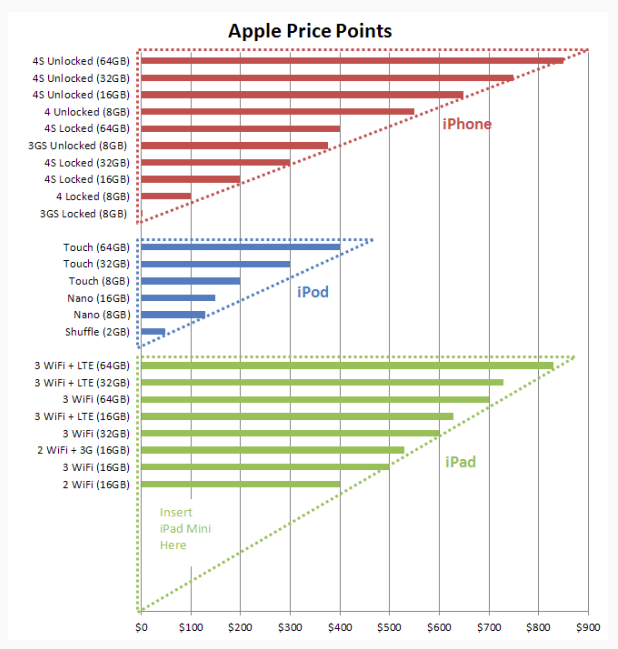
Business: The Reason for the iPad Mini

Eliminating the “price umbrella”.

The Reason for the iPad Mini: 

On a past Apple conference call, Tim Cook said "one thing we'll make sure is that we don't leave a price umbrella for people".  What's that? A price umbrella is when a company with dominant market share maintains high prices, leaving an opening for new competitors to enter at lower price points.  In the case of the iPad, the price umbrella until recently was at $499. Someone could enter that market at lower prices and exhibit classic disruption to push them out from the bottom up.
Apple has already solved this problem twice, with the iPod and iPhone.  So let's look at what they did. 
Source: iamconcise

Tuesday, July 24, 2012

Daily Links: July 24, 2012


Craigslist Joe, A Film About a Man Living Off Craigslist for a Month


Craigslist Joe is a documentary film produced by Zach Galifianakis that follows filmmaker Joseph Garner for 31 days & nights as he tries to find everything he needs off of Craigslist. Here’s the official trailer. It opens in theaters on August 2, 2012.

Get your Monday started with a little Elemental Balance. Use bombs to propel wood into fiery targets. Your rewards for success include confetti.

If you’re visiting China, you might be able to sample iPhone ice cream, which may or may not run afoul of trademark/copyright laws, depending on who you ask.

Having young kids makes you a little crazy - - the Wikipedia entry on Swiper the Fox from Dora the Explorer is 1,300 words of analysis:

Infographic: How Much Data is Created Every Minute?

http://24.media.tumblr.com/tumblr_m7ml7jMdTu1qij2hso1_500.jpg


Data never sleeps. Every minute massive amounts of it are being generated from every phone, website and application across the Internet. Just how much data is being created and where does it come from?

Monday, July 23, 2012

Video Distraction: Views from the ISS at Night


Knate Myers assembled this video from a series of time-lapse videos taken aboard the ISS. Plus, one of my favorite movie soundtracks! Naturally, go full-screen HD for best experience. The photos and original time-lapse videos are available from NASA-Johnson Space Center's Gateway to Astronaut Photography of Earth

Science: Learn Science While Playing Video Games


Learn Science While Playing Video Games?:
"Valve recently launched a free initiative called Teach With Portals that aims to help teachers use the game Portal 2 (click here for a review) to engage students in learning STEM and critical thinking. By converting its level-building software, Hammer Editor, into a much easier to use interface called Puzzle Maker, Valve has made it possible for anyone to design challenging Portal rooms. The Teach With Portals website also offers community-submitted lesson plans (here’s an example of a harmonic oscillator) that utilize the game and align with national STEM standards so teachers can directly incorporate them into their curriculum. Teachers can sign up for the ‘Steam for Schools‘ beta program, which offers a limited version of the popular Steam gaming platform that hosts the free version of Portal 2 and the Puzzle Maker.

Photo: IC1318


IC1318

LB-0005 image in narrowband Hubble palette This is a less often photographed region of the Cygnus nebula that is just south of the popular “butterfly”.


LB-0005 image in narrowband Hubble palette This is a less often photographed region of the Cygnus nebula that is just south of the popular “butterfly.”

Thursday, July 19, 2012

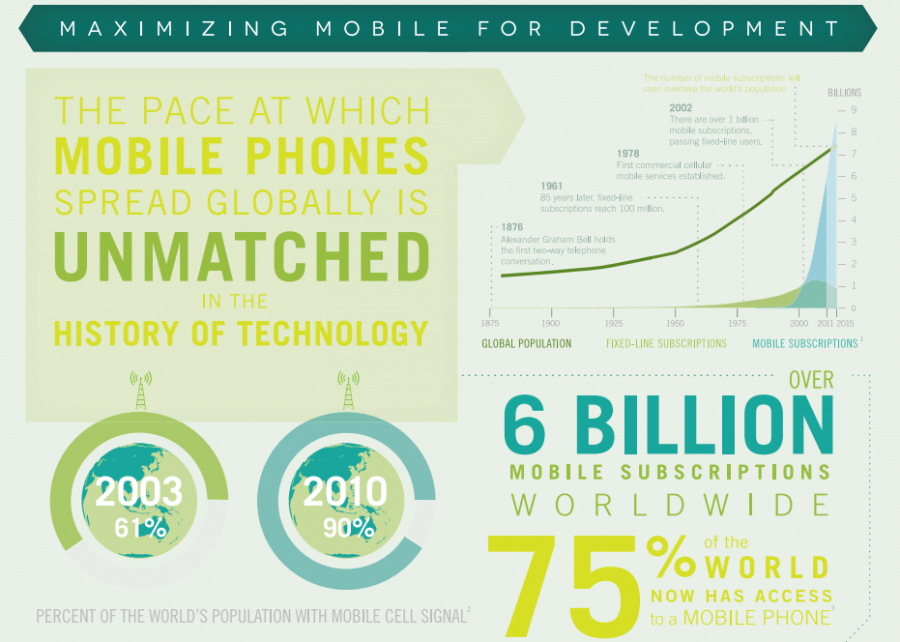
Infographic: How Cell Phones Are Changing The World

How Cell Phones Are Dramatically Changing The World


Polit­i­cal and eco­nom­ic ana­lysts alike have been awed by the pro­lif­er­a­tion of tech­nol­o­gy and social media to con­nect peo­ple and send ideas across bor­ders that never before been crossed.

Photo: Light of the Night


"Light of the Night" by Alexander Semenov

Wednesday, July 18, 2012

Lecture: Infinite Reality


Jeremy Bailenson shares his research on virtual reality, avatars, transformed social interaction, and related communication and psychological theories, as well as implications for citizens living in the digital age.

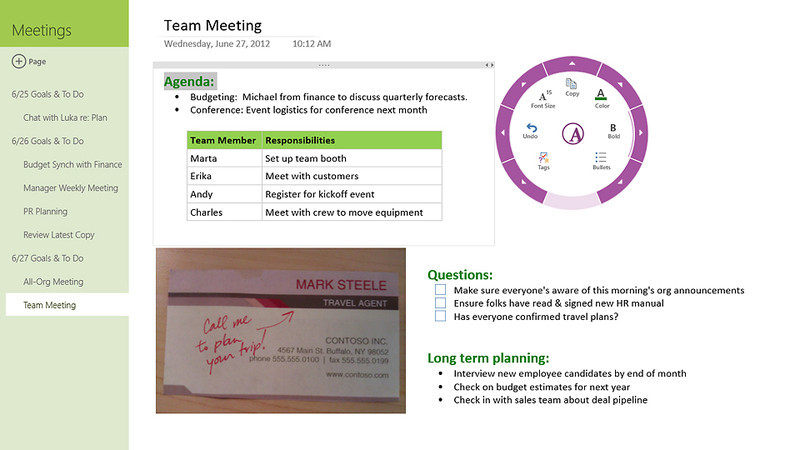
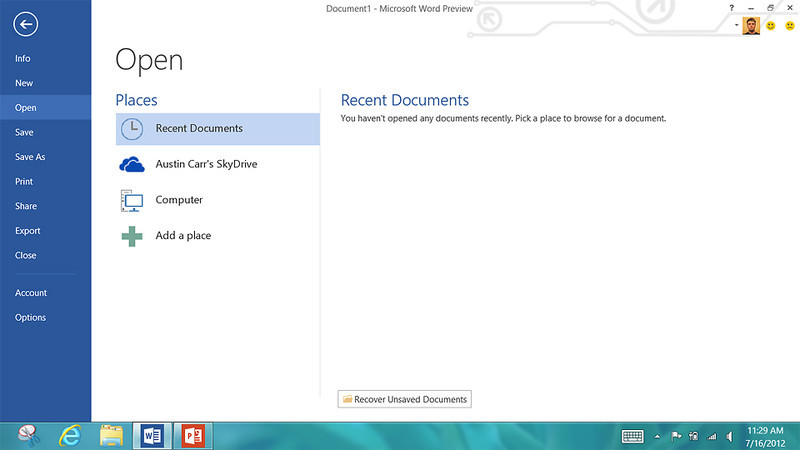
Software: What The New Microsoft Office Gets Wrong


What The New Microsoft Office Gets Wrong:
Windows 8, the most radical redesign of Microsoft’s flagship operating system, is often said to be schizophrenic. On the one hand, the user interface that first greets users is beautiful: a fun, playful grid of colorful tiles, based on Microsoft’s well-received Metro design language, that offers access to apps and content. On the other hand, hidden beneath this Metro-enhanced surface is the same desktop-based UI we’ve known for decades, still riddled with taskbars, toolbars, and drop-down menus.

Today, Microsoft unveiled a preview of its latest version of Office, and like Windows 8, the newest iterations of Word, Excel, and PowerPoint are just as split-minded. With roughly one billion users worldwide, Microsoft faced the same issues designing Office as it did Windows: How do you re-imagine a ubiquitous piece of software without alienating your global user base? While Microsoft designed this latest release for mobile, engineering the experience for touch-screen devices, and infusing elements of Metro’s design language into the program, Office 15 still feels slightly dated—bogged down by decades of legacy.
Source: FastCoDesign

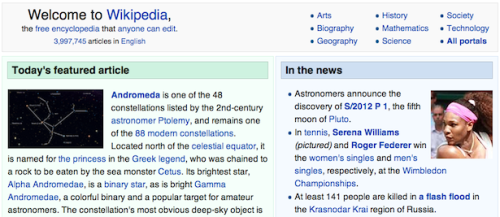
Net: On the Ugliness of Wikipedia


On the Ugliness of Wikipedia:
Here is an empirical truth about Wikipedia: Aesthetically, it is remarkably unattractive. The gridded layout! The disregard for mind-calming images! The vaguely Geocities-esque environment! Whether it’s ironic or fitting, it is undeniable: The Sum of All Human Knowledge, when actually summed up, is pretty ugly.

And: no offense intended. Because, on the one hand, the site’s homeliness is a feature rather than a bug. “Wikipedia has always been kind of a homely, awkward, handcrafted-looking site,” says Sue Gardner, executive director of the Wikimedia Foundation. And that homeliness, she notes, “is part of its awkward charm.” Wikipedia’s just-rolled-out-of-bed-looking interface sends a clear message to users, Gardner said, in a panel at today’s Wikimania conference. And that message is, basically, that the site has better things to do than obsess about its appearance. Wikipedia “is clearly not designed — at all — by marketing people,” Gardner notes. “It is clearly not trying to sell you something.” Which means that Wikipedia’s frank, unpretentious interface serves as a subtle reassurance: The site is not trying to monetize you.
Source: The Atlantic

Infographic: Evolution of the Web

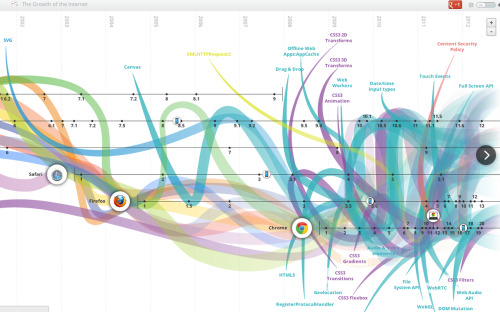
Evolution of the Web
Interactive infographic about the evolution of browsers and the web. This infographic features major web browsers since 1993 such as Mosaic, Netscape, Opera, Internet Explorer, Safari, Firefox, and Chrome, as well as key developments in web technologies such as HTML, CSS, and JavaScript.


Interactive infographic about the evolution of browsers and the web. This infographic features major web browsers since 1993 such as Mosaic, Netscape, Opera, Internet Explorer, Safari, Firefox, and Chrome, as well as key developments in web technologies such as HTML, CSS, and JavaScript.


Lecture: The Physics of Time Travel


Theoretical physicist Ronald Mallett has put himself on record that time travel will be figured out, despite the fact that most physicists don’t agree. It’s a nice idea, and while I’m skeptical that we will ever be able to accomplish the feat (wouldn’t we have received notification to that end by now?), the physics of how time is malleable is well accepted. It’s all about relativity.

So while you wait for you grandchildren to appear from thin air and tell you that we’ve figured it out, let Dr. Mallett explain Einstein’s time theories as part of the new EPIPHANY video series.

News: Scientists Fire the World’s Most Powerful Laser

Scientists Fire the World’s Most Powerful Laser
Hidden away at the Lawrence Livermore National Laboratory’s National Ignition Facility is a terrifying 10-story laser. Recently scientists have finally started using it in anger, and now they’ve even smashed previous records to fire the most powerful laser shot ever recorded.
The long-term plan, of course, is to use this incredibly high-powered laser to kick-start nuclear fusion reactions. So, we might even see some of that power make its way back to us at some point. [Lawrence Livermore National Laboratory via Popular Science]

Scientists Fire the World’s Most Powerful Laser:
Hidden away at the Lawrence Livermore National Laboratory’s National Ignition Facility is a terrifying 10-story laser. Recently scientists have finally started using it in anger, and now they’ve even smashed previous records to fire the most powerful laser shot ever recorded.

The long-term plan, of course, is to use this incredibly high-powered laser to kick-start nuclear fusion reactions. So, we might even see some of that power make its way back to us at some point. 
Source: Lawrence Livermore National Laboratory via Popular Science

Humor: "Snake Fight" Portion Of Your Thesis Defense

The “Snake Fight” Portion Of Your Thesis Defense:
Q: Do I have to kill the snake?

A: University guidelines state that you have to “defeat” the snake. There are many ways to accomplish this. Lots of students choose to wrestle the snake. Some construct decoys and elaborate traps to confuse and then ensnare the snake. One student brought a flute and played a song to lull the snake to sleep. Then he threw the snake out a window.

Q: Does everyone fight the same snake?

A: No. You will fight one of the many snakes that are kept on campus by the facilities department.

Q: Are the snakes big?

A: We have lots of different snakes. The quality of your work determines which snake you will fight. The better your thesis is, the smaller the snake will be.

Q: Does my thesis adviser pick the snake?

A: No. Your adviser just tells the guy who picks the snakes how good your thesis was.
Source: McSweeney’s Internet Tendency

Tech: Glasses-free 3-D TV at MIT


Like everyone said when 3d tv’s come out, “a true glasses-less version will be out in a few years.”
Well MIT has proved that it can be done with today’s tech and with a few iterations it should rival the 3d TV’s of today.

MIT’s Tensor Display creates glasses-free holovids from 3 LCDs:
As striking as it is, the illusion of depth now routinely offered by 3-D movies is a paltry facsimile of a true three-dimensional visual experience. In the real world, as you move around an object, your perspective on it changes. But in a movie theater showing a 3-D movie, everyone in the audience has the same, fixed perspective — and has to wear cumbersome glasses, to boot.

Despite impressive recent advances, holographic television, which would present images that vary with varying perspectives, probably remains some distance in the future. But in a new paper featured as a research highlight at this summer's Siggraph computer-graphics conference, the MIT Media Lab's Camera Culture group offers a new approach to multiple-perspective, glasses-free 3-D that could prove much more practical in the short term.

Instead of the complex hardware required to produce holograms, the Media Lab system uses several layers of liquid-crystal displays (LCDs), the technology currently found in most flat-panel TVs. To produce a convincing 3-D illusion, the displays would need to refresh at a rate of about 360 times a second, or 360 hertz. Such displays may not be far off: LCD TVs that boast 240-hertz refresh rates have already appeared on the market, just a few years after 120-hertz TVs made their debut.
Source: MIT

Photo: Night and Day

Stephen Wilkes

If photographer Stephen Wilkes couldn’t decide what time of day NYC was most beautiful, we understand. See his photographic series capturing the magic of Manhattan days and nights combined into one.

Tuesday, July 17, 2012

Video Distaction: Stopped Clock Illusion


Chronostasis is the illusion in which the first impression following a saccade (quick eye movement) appears to be extended in time. The most well-known version of this illusion is the stopped-clock illusion, where the first movement of the second hand of an analog clock, following the viewer’s directing attention to the clock, appears to take longer than the next movement.

When eyes execute a saccade, perception of time stretches slightly backward. The viewer’s brain registers that they have been looking at the clock for slightly longer than they really have, producing the illusion that the second-hand is frozen for more than a second. Although this happens every time the eyes move from one fixation point to the next, it is rarely noticed. One explanation is that the brain is filling in the gap while the eyes move from looking at one thing to the next.

Science: A Tour of the Moon


Although the moon has remained largely unchanged during human history, our understanding of it and how it has evolved over time has evolved dramatically. Thanks to new measurements, we have new and unprecedented views of its surface, along with new insight into how it and other rocky planets in our solar system came to look the way they do. See some of the sights and learn more about the moon here!

Source: NASAexplorer

Wednesday, July 11, 2012

Music: Song of the Higgs Boson

You may know that the Higgs Boson has been found, and you may even know what that means, but do you know what the Higgs Boson sounds like? Well now you can listen to it in person, thanks to Domenico Vicinanza, who has converted the ATLAS data on the new particle into music. The tune is surprisingly soothing, although it clearly wasn't composed by a musician.

Humor: YouTube Socks


Humor: If Websites Were People


If Websites Were People by iocomedytv.com