Friday, May 4, 2012

Photo: Epic


The DB Schenker warehouse in Berlin, Germany by Christian Stoll

The photography series "Epic" by Christian Stoll includes a sequence of spaces that have one thing in common: they are immense. These spaces may not have been designed using perpective renderings, but they are are engineered or urban planned to stunning effect, even if it’s accidental. These are vantage points that we aren’t used to seeing, even though the spaces facilitate or support processes ubiquitous to our daily lives. These are pictures of the staggering engineering that allows things happen quietly: an order ships, a file downloads, and the only time they occur to us is when something goes wrong. Even though thinking about a processing facility or bank of escalators may not sound too exciting, even quotidian spaces, from a particular vantage point, can be epic.


Thursday, May 3, 2012

Tech: Bionic Eye Expected by 2014

smarterplanet:

Bionic Eye Expected To Let The Blind See By 2014 - PSFK
With over 285 million visually impaired people in the world, research into restoring vision for the blind is well past its critical stage. But with innovations in technology, and by turning to a focus to even just restoring rudimentary vision, research suggests that a more expansive solution is on the near horizon. Better yet, it’s a solution that may serve as the foundation for something much more instrumental, for many more people.
A team of electrical engineers at the Monash Vision Group (MVG) of Monash University in Australia has had early success in doing just that. The group has been laboratory testing a new microchip that will be used to power a bionic eye. With pre-clinical assessments due to begin shortly, the team’s encouraging results suggest that the project is on track to deliver a direct-to-brain bionic eye implant ready for patient testing by the year 2014.
via PSFK: 

Bionic Eye Expected To Let The Blind See By 2014:

With over 285 million visually impaired people in the world, research into restoring vision for the blind is well past its critical stage. But with innovations in technology, and by turning to a focus to even just restoring rudimentary vision, research suggests that a more expansive solution is on the near horizon. Better yet, it’s a solution that may serve as the foundation for something much more instrumental, for many more people.
A team of electrical engineers at the Monash Vision Group (MVG) of Monash University in Australia has had early success in doing just that. The group has been laboratory testing a new microchip that will be used to power a bionic eye. With pre-clinical assessments due to begin shortly, the team’s encouraging results suggest that the project is on track to deliver a direct-to-brain bionic eye implant ready for patient testing by the year 2014.
Source: PSFK.com

Gadgets: Robot Hair Washer


So, my first reaction is that robots are awesome, but need could this bot possibly be fullfilling? I mean, there's hardly a shortage of barbers, is there? Then, I started thinking about how relaxing a good scalp massage is, and I realized, it's probably not going to be long before you can get one of these for your own bathroom.
Panasonic presents its Head Care Robot. The robot is designed to support staff at hospitals and care facilities with hair washing. The robot will undergo trials for 2 months at Hair Salon Super Seo in Nishiyama City, Hyogo Prefecture, Japan.

Factoid: Legos

“Today there are 75 bits of Lego for every person on the planet.”

Gadgets: NoteSlate

http://27.media.tumblr.com/tumblr_m3bpe0PivB1r7xdq2o1_1280.jpg

Introducing NoteSlate. This thing is pretty mind blowing with its sleek style yet awesome, simple functionality. The NoteSlate is designed to look like real paper and even comes up with a pen. It is a low cost tablet that can easily go with you anywhere and utilizes a simple and very helpful interface that makes writing an eNote easy for everyone. The NoteSlate battery lasts for nearly 180 hours, and comes equipped with a special pen and eraser, a mini-USB port, SD card slot, and even 3.5mm headphone jack for listening to mp3′s- a great bonus feature. You can pick up a NoteSlate for only 100 bucks.

Wednesday, May 2, 2012

Daily Links: May 2, 2012

Should I Check My Email? by Wendy Macnaughton

"Should I Check My Email?" by Wendy Macnaughton


10 Untranslatable Words (And When You'll Want to Use Them)

Homemade Star Trek phaser really will stun you

Stephen King on taxing the ultra-rich... including himself. An engaging -and colorful- discussion on taxes for the ultra rich.

You can now own the original floating home used by MACGYVER as his home in the TV series

Tech: Festo SmartInversion


Festo, has recently released a video featuring their newest high tech wonder, the Festo SmartInversion, a machine that moves through the air by turning itself inside out.
SmartInversion is a helium-filled flying object that moves through the air by turning inside-out. This constant, rhythmically pulsating movement is known as inversion and gives the flight model its name. With the intelligent combination of extreme lightweight construction, electric drive units and control and regulation technology, inversion kinematics can be indefinitely maintained to produce motion through the air.

Gadgets: KegDroid


“Betsy” is the name of the KegDroid beer dispensing system created by Googler and longtime homebrewer Paul Carff. In this video, Paul describes its mechanics and gives a rundown on how it works. It operates on a touch screen Android tablet.

Source: The Next Web

Tech Links: May 2, 2012


Source: Graphjam via Reddit


Entertainment


The 20 Best Biographies for Tech-Minded Students

E-mail Addresses It Would Be Really Annoying to Give Out Over the Phone.

Some mad genius went and created a perfect working 12-inch tall Star Wars coin-op arcade game cabinet. Just click the video embed in that forum thread to see and marvel.

News


The Cyber Intelligence Sharing and Protection Act (CISPA) is a controversial surveillance bill that proposes broad legal exemptions for the U.S. government and private companies to share "cyber threat intelligence" that go well beyond the FISA Amendments Act which legalized the NSA's warrantless wiretapping program.

The Pirate Bay must be blocked by UK ISPs, court rules

Reading & Discussion


Bit rot: The world is losing its ability to reconstruct history. Better regulation could fix that

How a console firmware update could make a small dent in our energy problem

The origin of the Blink tag

Shakespeare: All the web is a stage

Science


Digital Aeronautical Charts

Scientists have claimed they’ve created a small crystal that works like a quantum computer. Said computer is so powerful (by whatever measure they’re using) that you’d need a contemporary silicon computer the size of the universe to match it. It’s just as well we have the crystal one. Crystals are cool and I barely have enough room to keep my stuff out of the rain as it is.

"We measure, in a single experiment, both the radiation pressure and the torque due to a wide variety of propagating acoustic vortex beams. The results validate, for the first time directly, the theoretically predicted ratio of the orbital angular momentum to linear momentum in a propagating beam. We experimentally determine this ratio using simultaneous measurements of both the levitation force and the torque on an acoustic absorber exerted by a broad range of helical ultrasonic beams produced by a 1000-element matrix transducer array." In other words, science has created the sonic screwdriver, and it could mean new advances in non-invasive surgery. The official release from the University of Dundee, plus a couple of videos. Still doesn't work on wood.

Writing in the New York Review of Books, Nobel laureate Steven Weinberg discusses his reason for suspecting that advances in particle physics and astronomy will not just slow down in the coming years, but cease entirely.

Technology


It is well known that the US military and their allies use unmanned aerial drones overseas in wars and other operations. But there are also hundreds in operation here in the U.S., according to records the Federal Aviation Administration has recently released. Local police departments already have used them in SWAT situations, and the Department of Homeland Security has given the green light for them to deploy a drone helicopter that can supposedly taze suspects from above as well as carrying 12-gauge shotguns and grenade launchersas well as providing surveillance. Congress has paved the way for as many as 30,000 drones in the skies over the US by 2020, which has privacy advocates alarmed. The Electronic Frontier Foundation has created a map with all of the organizations that have permits to use drones within the confines of the US.

Tutorials


100 Serious Twitter Tips for Academics

Monday, April 30, 2012

Video: If LinkedIn Was Created In the 1980s


Squirrel Monkey imagines what LinkedIn might have looked like if it was created in the 1980s.

News: Olympics to ban social network photos?

Olympics to ban social network photos?: 
"The London 2012 conditions state: ‘Images, video and sound recordings of the Games taken by a Ticket Holder cannot be used for any purpose other than for private and domestic purposes and a Ticket Holder may not license, broadcast or publish video and/or sound recordings, including on social networking websites and the internet more generally, and may not exploit images, video and/or sound recordings for commercial purposes under any circumstances, whether on the internet or otherwise, or make them available to third parties for commercial purposes.’

Ruck, a semi-retired freelance, blasted the rules as unenforceable.

He said there will be a 'million and one' people taking photos and video, whether by camera or mobile camera phone."
Source: Amateur Photographer

OpEd: The world is losing its ability to reconstruct history

Bit rot: The world is losing its ability to reconstruct history:
PICTURE yourself as a historian in 2035, trying to make sense of this year’s American election campaign. Many of the websites and blogs now abuzz with news and comment will have long since perished. Data stored electronically decays. Many floppy disks from the early digital age are already unreadable. If you are lucky, copies of campaign material, and of e-mails and other materials (including declassified official documents), will be available in public libraries.

But will you be able to read them? Already, NASA has lost data from some of its earliest missions to the moon because the machines used to read the tapes were scrapped and cannot be rebuilt. A wise librarian will wish to keep in working order a few antique computers that can read such ancient technologies as CDs and USB thumb-drives. But even that may not be enough. Computer files are not worth anything without software to open them.

One way round that is to print everything out. If you use durable acid-free paper, this will reach at least the level of accessibility of medieval manuscripts, handwritten on vellum. But printouts of digital material are a second-best solution. They risk losing the metadata that make documents interesting: e-mails make most sense as threads, not as stacks of paper. Only in digitised form can data be sifted and crunched.

Source: The Economist

Video Distraction: Anthropocene Animation


Tech: Teaching Robots How to Spin a Web

Teaching Robots How to Spin a Web

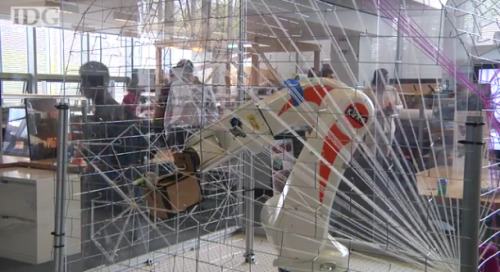
As Nick Barber of IDG News reports, the Mediated Matter Group at MIT’s Media Lab is working on a robot it hopes will one day be able to scan its surroundings and weave a structure that’s attached to elements in the environment.
The machine isn’t able to do this just yet, but… it can be preprogrammed to weave a pretty mean web using pegs and hooks that it’s been told the positions of.
The researchers, who also study 3D printing, drop phrases like “additive manufacturing processes” and say that eventually they’ll replace the yarn shown in the video with nylon that will harden once it’s put in place. One can imagine manufacturing or construction methods that involve a machine that works with a given physical framework to create custom designs.
“We’re working on the sensing so it knows where it’s going on its own,” Research Assistant Elizabeth Tsai says in a short article by Barber.

(via MIT’s web-spinning robot: Be very afraid? | Cutting Edge - CNET News)

MIT's web-spinning robot: Be very afraid?
As Nick Barber of IDG News reports, the Mediated Matter Group at MIT’s Media Lab is working on a robot it hopes will one day be able to scan its surroundings and weave a structure that’s attached to elements in the environment.
The machine isn’t able to do this just yet, but… it can be preprogrammed to weave a pretty mean web using pegs and hooks that it’s been told the positions of.
The researchers, who also study 3D printing, drop phrases like “additive manufacturing processes” and say that eventually they’ll replace the yarn shown in the video with nylon that will harden once it’s put in place. One can imagine manufacturing or construction methods that involve a machine that works with a given physical framework to create custom designs.
“We’re working on the sensing so it knows where it’s going on its own,” Research Assistant Elizabeth Tsai says in a short article by Barber.
Via: CNET News

Video Distraction: Building Tetris


On April 20th, hackers at MIT converted the Green Building on campus into a giant playable game of Tetris.

Via: BostInno & Hacker News


Gadgets: Brydge

Brydge, Keyboard Attachment That Converts iPad into Laptop

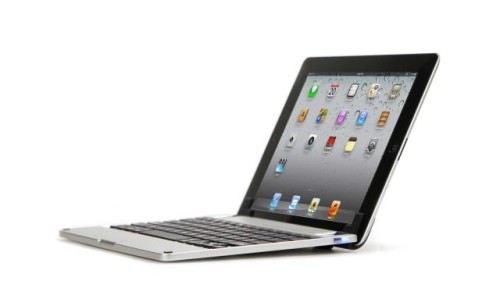
Brydge is a combination keyboard and case for iPad that when attached, converts the tablet into a laptop. It is made of machined aluminum and attaches to the iPad with a special quick release hinge. Brydge is by Los Angeles-based designer Brad Leong, Sam, & Eddy. They are currently raising funds for the project on Kickstarter.

Humor: IE Infographics


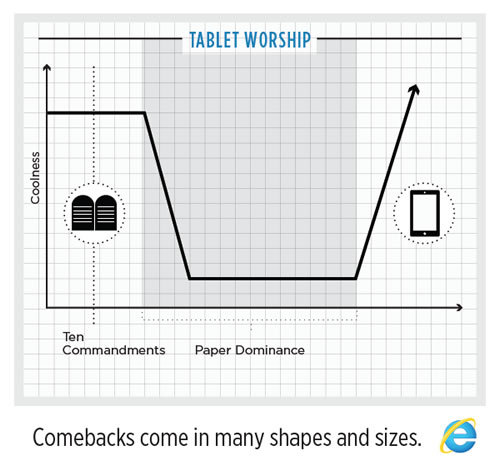
Cool campaign from - wait for it - Internet Explorer. I know, right? Who would have thought it. But its funny, simple and honest.


Sunday, April 29, 2012

OpEd: Does the Internet Breed Killers

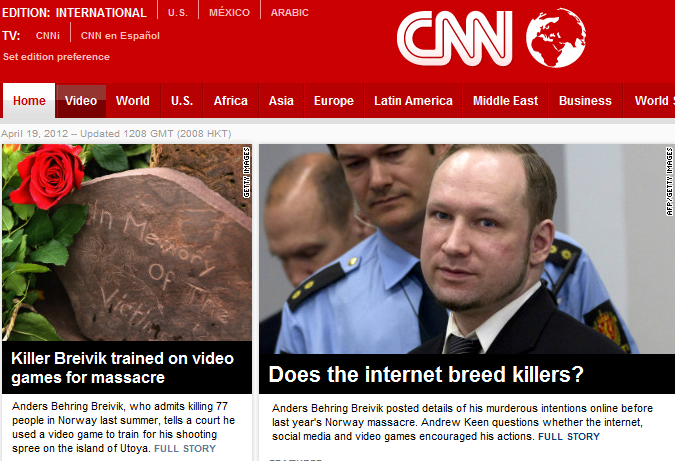
Does the internet breed killers?

Does the internet breed killers?
"Indeed, virtual networks like Facebook, YouTube, Wikipedia and the World of Warcraft seem to offer as good clues as any to why this 32 year-old man should decide one day to blow up and shoot as many fellow Norwegians as he could.

Most troubling of all is Breivik’s obsession with the multiplayer role-playing World of Warcraft, a violent online game that he played “full-time” between 2006 and 2007. Indeed, one of the few times that he smiled this week was when the image of his World of Warcraft character was displayed in court."
Source: CNN

Note: I just want to let all of you know that we’re all killers... and CNN's oped pieces have recently become very questionable of late.

Friday, April 27, 2012

Net: Zerg Rush


1.) Go to Google Search and type in "zerg rush"
2.) Lose twenty minutes of your life.