Friday, March 30, 2012

Lecture: Humanize your Data


This video is a bit long, but Jer Thorp, a creative computer geek, keeps you pretty entertained the whole time and he has some really funky graphs making data quite aesthetic. I think it’s worth watching to the end to hear him make his point about how we need to put data in a human context, to tether it to the real world and give it real meaning.

Source: TED

Tech: Military Robotics


Robotic arms precise enough to lift a light bulb, yet strong enough to lift a set of weights. Robots that can search suspicious territory first without requiring a human being. Robots that can push around suspicious cars, break into them and take out the explosive device, safely away from any humans.

Representatives from robotics companies including iRobot and HDT Robotics, as well as government developers, were in attendance at an annual robotic conference which was held this year on Harbor Island in San Diego.

Source: SBS World News

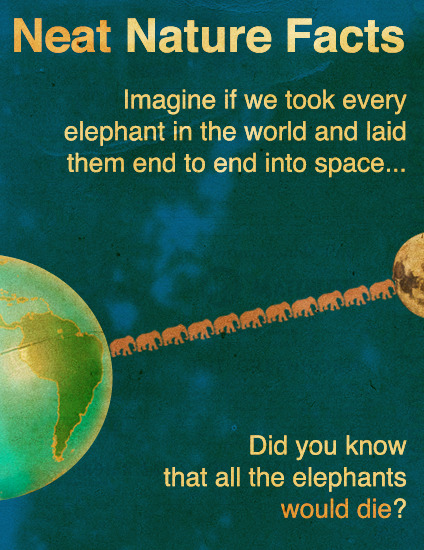
Humor: If you Lined up all the Elephants…

Neat Nature Facts

I don’t know why they call their site Fake Science; this seems very accurate to me.

Photo: Lava Crater


Another amazing capture from ESA astronaut André Kuipers, from his vantage point on the International Space Station. André travelled to the orbital outpost in December 2011, and will remain in orbit for more than 6 months as part of ESA’s long duration mission, PromISSe.

Thursday, March 29, 2012

Astronomy: Aperture Spherical Radio Telescope


"A Big Eye on the Sky" by Guillermo Munro

The 500-meter Aperture Spherical radio telescope (FAST) will take over as the biggest radio telescope in the world. The amazing thing about FAST is that is gigantic and still it’s able to move in angles and change its radius. Its being constructed in the beautiful valley of Guizhou in South China and will be completed in just over four years. The Telescope will be able to help scientists see the origin of the Universe, dark matter and look for extraterrestrial life.

Source: China Daily


News: James Cameron's Record-Breaking Trench Dive


James Cameron Completes Record-Breaking Mariana Trench Dive:
Explorer and filmmaker James Cameron reached the deepest part of the Pacific Ocean at 7:52 am Monday local time (2152 GMT Sunday) in his specially designed submersible. He is the first person to dive there solo and reach a depth of 35,756 feet (10,898 meters), since it was initially explored in 1960.

Gadgets: Noisy Jelly

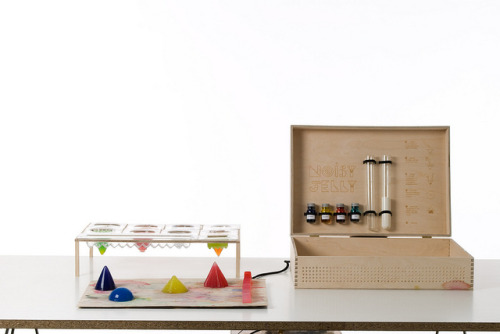
Noisy Jelly, A Musical Jelly Game for Kids

Noisy Jelly is a learning game in which kids make their own electronic music instruments out of jelly. When placed on the game board, the jelly shapes become capacitive sensors and play sounds whenever they are touched. Noisy Jelly is a design concept by French design students Raphaël Pluvinage and Marianne Cauvard. Via: MAKE

Science: Geologic Time Scale

Science!!!


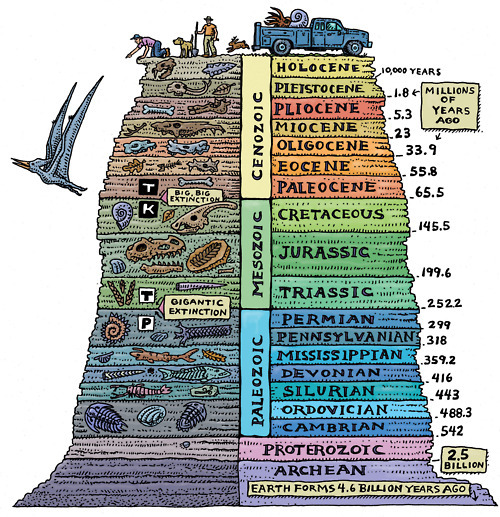
One of the coolest nuances about our planet earth is that it curates its own museum of natural history through the fossil record. It is truly remarkable that tangible specimens of early invertebrates, the first jawed fishes, primitive amphibians, the first feathered dinosaurs (who grandfathered all modern birds!), and many, many proto-humans have been preserved til present day. The tree of life is a grand old thing, of which we're just one small branch!

I’d like this chart more if it had the Carboniferous rather than American name. It ought to read Precambrian, Cambrian, Ordovician, Silurian, Devonian, Carboniferous, Permian, Triassic, Jurassic, Cretacious, Tertiary, Quarternary.  Just remember the mnemonic, "Pregnant Camels Often Sit Down Carefully, Perhaps Their Joints Creak Too Quietly."
Gadgets: The Tricorder Project


One of the most beautiful aspects of science is that while there is so much we can see and smell and feel around us, there's an inconceivably large universe around us full of things we can't directly observe. The Tricorder project aims to develop handheld devices that can sense a diverse array of phenomena that we can't normally see, and intuitively visualize them so we might see temperature or magnetism or pressure as naturally as we see colour.

Tech: NUIverse


Demonstration of the NUIverse application designed by David Brown for the Samsung SUR40 for Microsoft Surface.

Photo: Grand Star-Forming Region


This massive, young stellar grouping, called R136, is only a few million years old and resides in the 30 Doradus Nebula, a turbulent star-birth region in the Large Magellanic Cloud. There is no known star-forming region in the Milky Way Galaxy as large or as prolific as 30 Doradus.

Many of the diamond-like icy blue stars are among the most massive stars known. Several of them are 100 times more massive than our sun. These hefty stars are destined to pop off, like a string of firecrackers, as supernovas in a few million years.

Wednesday, March 28, 2012

Gadgets: The Sand Flea


Damn! Gone are the decades in which we could escape the Daleks by running up a staircases.

Sand Flea is an 11-lb robot with one trick up its sleeve: Normally it drives like an RC car, but when it needs to it can jump 30 feet into the air. An onboard stabilization system keeps it oriented during flight to improve the view from the video uplink and to control landings. Current development of Sand Flea is funded by the The US Army's Rapid Equipping Force. For more information visit Boston Dynamics.

Video Distraction: Perpetual Ocean


This visualization shows ocean surface currents around the world during the period from June 2005 through Decmeber 2007. The visualization does not include a narration or annotations; the goal was to use ocean flow data to create a simple, visceral experience.

This visualization was produced using NASA/JPL's computational model called Estimating the Circulation and Climate of the Ocean, Phase II or ECCO2.. ECCO2 is high resolution model of the global ocean and sea-ice. ECCO2 attempts to model the oceans and sea ice to increasingly accurate resolutions that begin to resolve ocean eddies and other narrow-current systems which transport heat and carbon in the oceans.The ECCO2 model simulates ocean flows at all depths, but only surface flows are used in this visualization. The dark patterns under the ocean represent the undersea bathymetry. Topographic land exaggeration is 20x and bathymetric exaggeration is 40x.

Photo: Mosaic of the Galactic Center


This composite color infrared image of the center of our Milky Way galaxy reveals a new population of massive stars and new details in complex structures in the hot ionized gas swirling around the central 300 light-years.

This sweeping panorama is the sharpest infrared picture ever made of the Galactic core, revealing details in objects as small as 20 times the size of our own solar system. The picture measures 300×115 light-years and required 144 Hubble orbits to make 2,304 science exposures. It was taken between Feb. 22 and Jun. 5, 2008.

Tuesday, March 27, 2012

Gadgets: Robotic Mobility Device for Paraplegics


The TEK Robotic Mobility Device allows people who cannot walk due to spinal cord injury to stand up and move around with independence. As this intro video shows TEK RMD users can board the device without assistance, perform everyday tasks like cooking and shopping, and interact with others at eye level. TEK RMD was created by AMS Mekatronic, a Turkish research and development company. Via: Reuters

Net: Google Tour of the Amazon


Last August, Google sent a team to Brazil to create Street View maps of some of the waterways, forests, and villages of the Amazon Basin.

Video Distraction: Giant Paper Airplane Flies


On March 21, the PIMA Air & Space Museum successfully launched a 45 foot long paper airplane from a helicopter in the skies over Arizona. This video is our first glimpse into the dramatic, historic flight. Via: CNET News

Interview: Futurist Stowe Boyd


IBMSocialBiz ( IBM blogger Todd Watson) interviews Stowe Boyd at South By Southwest Interactive 2012 (SXSWi 2012)  from the IBM Future of Social Lounge. Boyd talks about Cluetrain, the social revolution online, work media tools, the impact on media companies, the changing way we read, and his upcoming ebook, The Business Of Social Business.

Photo: The Prague Orloj