The Cool Clouds of Carina
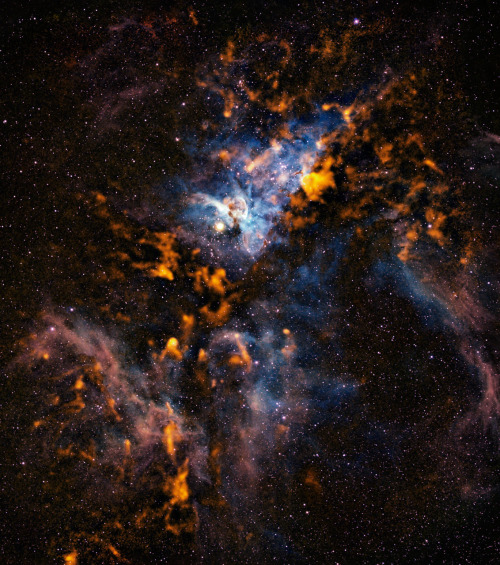
Observations made with the
APEX telescope in
submillimetre-wavelength
light at a wavelength of 870 µm reveal the cold dusty clouds from which
stars form in the Carina Nebula. This site of violent star formation,
which plays host to some of the highest-mass stars in our galaxy, is an
ideal arena in which to study the interactions between these young stars
and their parent molecular clouds.
At this wavelength, most of the light seen is the weak heat glow from
cosmic dust grains. The image therefore reveals the clouds of dust and
molecular gas — mostly hydrogen — from which stars may form. At -250°C,
the dust grains are very cold, and the faint glow emanating from them
can only be seen at submillimetre wavelengths, significantly longer than
those of visible light.
The APEX
LABOCA observations are shown here in orange tones, combined with a visible light image from the
Curtis Schmidt telescope.
The result is a dramatic, wide-field picture that provides a
spectacular view of Carina’s star formation sites. The nebula contains
stars with a total mass equivalent to over 25,000 Suns, while the mass
of the gas and dust clouds is that of about 140,000 Suns.