Showing posts with label 3d printing. Show all posts

Tuesday, March 12, 2013

Tech: 3-D Printing in Space


Open-Sourcing Outer Space: 3-D Printing Meets Rocket Science:

From 3D printed moonbases to architectural wonders more to down to Earth, as we saw what awesome mixture 3D printing and architecture could bring, I was left wondering about what other technologies we could be remixing 3D printers with. Partially answering my curiosity, Wired highlights an exciting new world of Rocket science.. now 3D print compatible? Apparently so!

Sure, a 3-D printed car is cool, but it doesn’t go to space. And there’s probably a good reason for that, but now a competition is aiming to launch the newest manufacturing fad into the final frontier by challenging people to design 3-D printed rocket engines.

Wednesday, September 12, 2012

Tech: 3D-Printed Exoskeleton


3D-printed exoskeleton gives a little girl use of her arms:
Two-year-old Emma was born with a rare disease called arthrogryposis that makes it so she can’t raise her arms without assistance. Through the use of 3D printing, a Delaware hospital created a mobile plastic exoskeleton that now allows Emma to use her arms for many things.

3D printing ensures that a new exoskeleton can be created if Emma breaks or outgrows it. Emma is now on her second 3D-printed jacket and calls the device her “magic arms.”

The video was created by 3D printing business Stratasys, which recently merged with Objet in a $1.4 billion deal. A Stratasys 3D printer was used to create Emma’s jacket.
Source: nextbigfuture

Monday, July 30, 2012

Tech: The world’s first 3D-printed gun

“Gun enthusiast “HaveBlue” has documented in a blog post (via the AR15 forums) the process of what appears to be the first test firing of a firearm made with a 3D printer, The Next Web reports. Actually,. the only printed part of the gun was the lower receiver. But, according to the American Gun Control Act, the receiver is what counts as the firearm. HaveBlue reportedly used a Stratasys 3D printer to craft the part, assembled it as a .22 pistol and fired more than 200 rounds with it.”
(via The world’s first 3D-printed gun is a terrifying thing | KurzweilAI)

The world’s first 3D-printed gun is a terrifying thing:
“Gun enthusiast “HaveBlue” has documented in a blog post (via the AR15 forums) the process of what appears to be the first test firing of a firearm made with a 3D printer, The Next Web reports. Actually,. the only printed part of the gun was the lower receiver. But, according to the American Gun Control Act, the receiver is what counts as the firearm. HaveBlue reportedly used a Stratasys 3D printer to craft the part, assembled it as a .22 pistol and fired more than 200 rounds with it.”
Source: KurzweilAI


Tuesday, May 29, 2012

Tech: DIWire Bender

The DIWire Bender is a rapid prototyping machine that can make 2D and 3D forms out of metal wire. The machine was created by PENSA, a design consultancy in Brooklyn. PENSA intends to open source the DIWire Bender in the coming weeks.

Wednesday, April 18, 2012

Great Design: 3D Printed Chairs


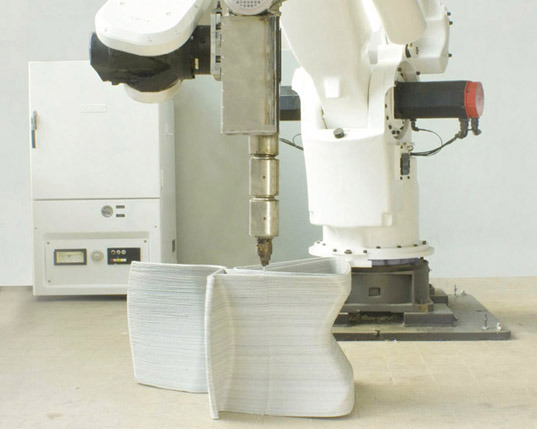
Here's an interesting project that combines ecology, design, and robotics. Electronic waste gets grounded into a paste which is used as the material to construct a chair by a robotic arm.
Dirk Vander Kooij is set to unveil a new line of “Endless” furniture made from recycled e-waste at “The Future in the Making”, an exhibition organized by Domus that will take place during Milan Design Week 2012. The young winner of the 2011 Dutch Design Award has reprogrammed an old industrial robot to extrude electrical appliances into chairs and tables. Vander Kooij, who until now has focused on synthetics, will present a new and different range of materials in Milan.

Wednesday, March 14, 2012

Tech: Muscle tissue produced with a 3D printer


Muscle tissue produced with a 3D printer:

San Diego startup Organovo has developed a bioprinting technique which allows it to create human tissue starting with any cell source. The printer deposits lines of cells closely together, where they are allowed to grow and interconnect until they form working muscle tissue.
Unlike other experimental approaches that utilize ink-jet printers to deposit cells, Organovo’s technology enables cells to interact with each other the way they do in the body. How? They are packed tightly together, sandwiched, if you will, and incubated. This prompts them to cleave to each other and interchange chemical signals. When printed, the cells are grouped together in a paste that helps them grow, migrate, and align themselves properly. In the case of muscle cells, the way they orient themselves in the same direction allow for contractions of the tissue.
The company hopes to one day build entire organs for transplants. Because tissue is able to be built from a patient’s own cells, the risk of rejection would be very low.

Source: MFoundation Blog

Friday, February 10, 2012

Tech: Researcher Creates Plane Using 3D Printer


Using only a 3D printer, researcher Jim Scanlan from the University of Southampton has created a fully functional plane. Even moving parts were created using the printer, all in one go.

Source: New Scientist

Thursday, February 2, 2012

OpEd: Why 3-D Printing Will Go the Way of Virtual Reality

Why 3-D Printing Will Go the Way of Virtual Reality:
This isn’t just premature, it’s absurd. 3-D printing, like VR before it, is one of those technologies that suggest a trend of long and steep adoption driven by rapid advances on the systems we have now. And granted, some of what’s going on at present is pretty cool—whether it’s in rapid prototyping, solid-fuel rockets, bio-assembly or just giant plastic showpieces.
But the notion that 3-D printing will on any reasonable time scale become a “mature” technology that can reproduce all the goods on which we rely is to engage in a complete denial of the complexities of modern manufacturing, and, more to the point, the challenges of working with matter.
Hype is inevitably followed by some level of backlash, or at least disinterest, and it would be a shame for 3-D printing to head into a too-deep trough of the Gartner hype cycle. There will be plenty of interesting applications for 3-D printing, but I’ll bet the ones that will have the biggest impact will be within traditional factories, where rapid prototyping is already having a huge impact.
I believe this is right. That is why it is interesting to try to look where 3D print might have a unique advantage. Following Bruce Sterlings early insights about this I think one of these possible areas are places on the planet where they don’t have access to factories yet, but is in need of things – many cheap, small but specialized things like e g spare parts for important machines.

Update: Ian Pearson commented on Twitter on this post by noting that 3D print will create a great digital craft industry, which I agree with. And that is a whole interesting area in itself since a whole new craft area will most likely redefine how we relate to design and production. Maybe not for everything but for the things that are perceived to be special and we really like and have emotional relations.

Tech: The Future of 3D Printing


MakerBot’s Bre Pettis says his 3D printers are for everyone. 3D Systems’ Cathy Lewis begs to differ.